
The most prestigious zip code in Atlanta isn't always the most intelligent investment for your clinical practice. While a Buckhead address offers visibility, the escalating overhead in traditional hubs often erodes the profitability you've worked to build. Understanding the average cost of medical office rent Atlanta requires more than a simple price-per-square-foot calculation. It demands a sophisticated look at how location, lease structures, and patient accessibility intersect to define true value in 2026.
You're likely frustrated by opaque pricing and the hidden costs of aging hospital campus infrastructure. We'll provide the clarity you need to make a decisive move. This guide breaks down current market rates, decodes the nuances of NNN versus Gross leases, and identifies high-value submarkets like Tucker and Northlake. You'll gain a strategic framework to evaluate your options and select a boutique environment that reflects your professional excellence. It's time to move beyond the mundane and secure a space that prioritizes both your patient experience and your bottom line.
Key Takeaways
- Identify how the 2026 shift toward decentralized outpatient care is driving demand and strategic pricing within the Northlake medical corridor.
- Benchmark the average cost of medical office rent Atlanta to distinguish between high-premium urban hubs and high-value suburban clinical pockets.
- Navigate the financial nuances of Triple Net (NNN) lease structures and the rare availability of Full-Service Gross options in modern developments.
- Evaluate critical operational metrics, such as specialized parking ratios and cybersecurity-ready infrastructure, that define a building’s long-term utility.
- Discover the strategic advantage of boutique, customizable medical suites in fostering patient retention and reflecting a high-end professional identity.
The 2026 Atlanta Medical Real Estate Landscape
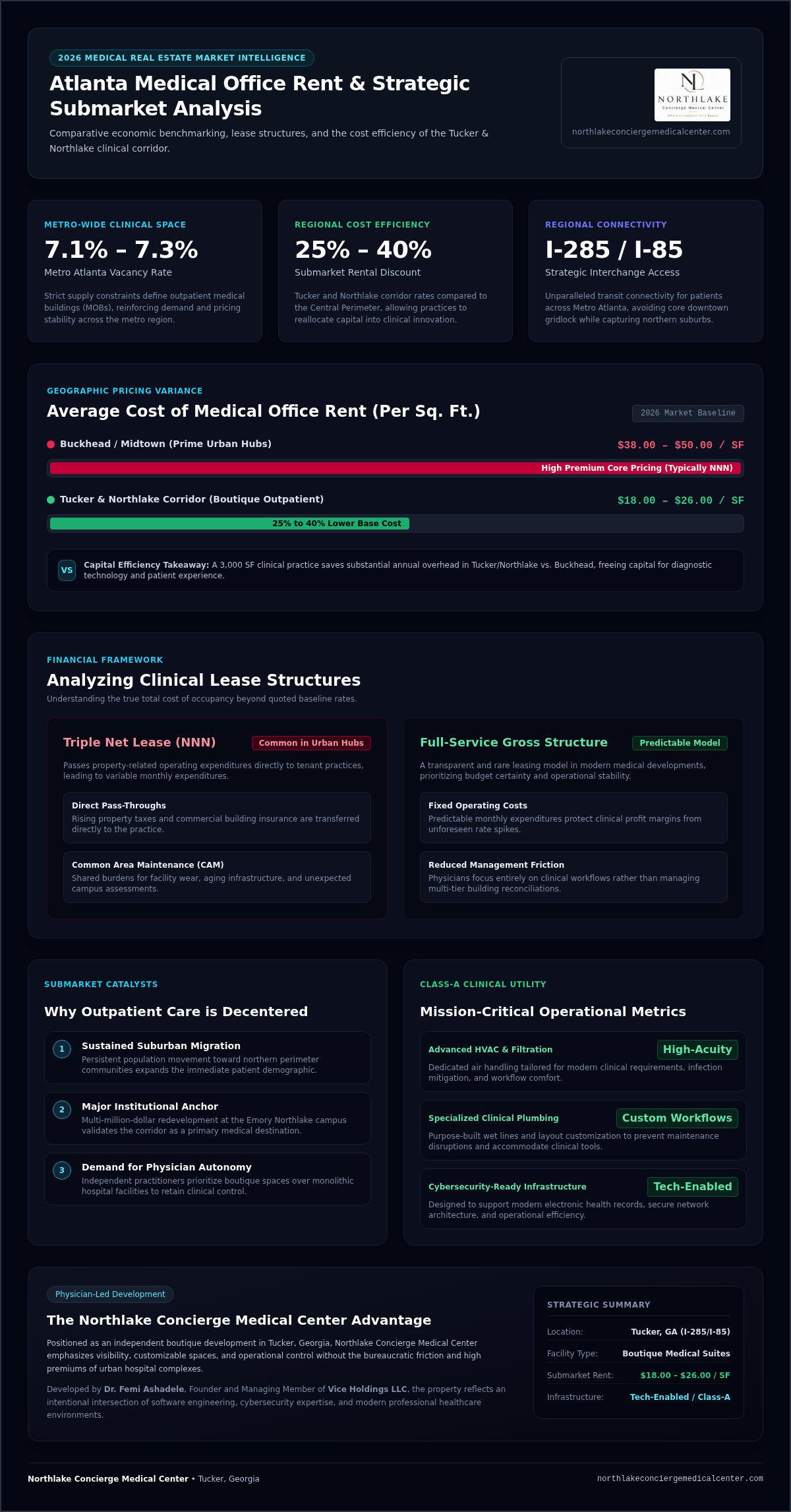
The Atlanta medical real estate market in 2026 is defined by a flight to quality and a sharp pivot toward outpatient accessibility. While traditional office sectors struggle with high vacancy, medical outpatient buildings (MOBs) maintain a resilient posture. Metro-wide vacancy rates for clinical space hover between 7.1% and 7.3%, reflecting a significant supply constraint. This scarcity means that the average cost of medical office rent Atlanta serves as a baseline for negotiation rather than a fixed budgetary ceiling. Specialists requiring high-acuity infrastructure or bespoke clinical layouts must account for the specific technological demands of their practice when calculating total occupancy costs.
Market Drivers: Why Atlanta Remains a Healthcare Hub
Population density continues to shift toward the northern suburbs, pulling clinical demand away from the city's saturated core. The influence of major healthcare systems remains undeniable. Institutional anchors, such as the multi-million-dollar redevelopment of the Emory Northlake campus, provide a stabilizing effect on local market rates by establishing a permanent patient draw. This institutional presence validates the corridor as a primary medical destination for independent physicians and specialists. Key drivers influencing current demand include:
- Sustained Migration: Persistent growth near the I-85/I-285 interchange increases the local patient base.
- Institutional Investment: Nearby hospital-grade infrastructure improvements bolster property values.
- Physician Autonomy: An increasing desire for tech-enabled buildings that offer complete operational control.
The 2026 market is increasingly defined by physician-led developments that prioritize operational efficiency over corporate scale. Dr. Femi Ashadele, the developer behind Vice Holdings LLC, has focused on this intersection of technology and professional functionality to meet the needs of modern practices.
Submarket Variance: Buckhead vs. Tucker and Northlake
Geographic positioning dictates your overhead. In prime urban hubs like Buckhead or Midtown, lease rates command a significant premium, frequently reaching $38.00 to $50.00 per square foot. These markets often utilize triple net (NNN) lease structures that pass rising property taxes and insurance directly to the tenant. In contrast, the Tucker and Northlake corridor offers a compelling value proposition. With average rents ranging from $18.00 to $26.00 per square foot, physicians can secure Class-A environments at a 25% to 40% discount compared to the Central Perimeter.
Accessibility serves as a primary differentiator for this submarket. The I-285 and I-85 interchange provides unparalleled visibility and ease of access for a regional patient base. Independent specialists are gravitating toward boutique destinations like Northlake Concierge Medical Center. These facilities offer the prestige of high-end design without the friction of massive hospital campuses. You can view the architectural renderings to see how modern aesthetics are being integrated into the Tucker landscape. This shift allows practitioners to reinvest their real estate savings into advanced technology and patient experience rather than inflated rent.
Benchmarking Rent: Class-A vs. Class-B Medical Suites
The average cost of medical office rent Atlanta is inextricably linked to the building's classification. While a simple price-per-square-foot figure offers a baseline, it fails to capture the gap in clinical utility and patient experience. Class-A properties represent the market's upper tier, providing purpose-built environments for high-acuity specialists and concierge practitioners. These assets strictly adhere to BOMA building class standards, which categorize spaces based on infrastructure quality, architectural sophistication, and management excellence. Choosing between these tiers is a decision that impacts both your operational overhead and your practice’s brand identity.
Class-A Standards: What Physicians Are Paying For
Physicians selecting Class-A suites are investing in more than just a modern lobby. They're securing mission-critical infrastructure, including advanced HVAC systems for air filtration and specialized plumbing tailored for clinical workflows. These modern systems reduce technology friction and minimize long-term maintenance disruptions. In a concierge or aesthetic practice, the physical environment serves as a powerful patient retention tool. Aesthetic excellence isn't a luxury; it's a differentiator. When a patient enters a design-forward professional environment, it reinforces the prestige of the practice. You can view our architectural renderings to see how these visual standards manifest in a boutique setting.
The Class-B Alternative: Cost Savings vs. Hidden Risks
Class-B buildings often present an attractive lower base rent, yet they frequently hide escalating operational costs. Older medical facilities often struggle with ADA compliance hurdles, outdated elevator systems, and insufficient parking ratios that frustrate both staff and patients. There's also a significant risk regarding brand perception. An aging medical building can create a visual stigma that contradicts a physician’s reputation for innovation and modern care. Independent specialists are increasingly migrating toward boutique Class-A developments to ensure their physical space reflects their professional identity.
Dr. Femi Ashadele and Vice Holdings LLC have designed the Northlake project to bridge the gap between high-end hospitality and clinical reliability. This approach ensures that the infrastructure supports the most demanding medical technologies while providing a serene experience for patients. If you're looking to elevate your practice brand and move away from the limitations of aging facilities, contact our team to discuss build-to-suit opportunities in the Tucker corridor.
Analyzing Lease Structures: NNN vs. Full Service
Calculating the average cost of medical office rent Atlanta requires a precise understanding of lease structures. The base rent is rarely the final figure on a monthly statement. In the current market, the shift toward Triple Net (NNN) leases has become nearly universal for modern Class-A developments. This structure separates the base rent from the property's operating expenses, creating a transparent but variable financial commitment. While Full-Service Gross leases offer predictable monthly payments, they're increasingly rare in specialized medical environments. Some landlords offer a Modified Gross middle ground, where the tenant pays a base rent plus a proportional share of operating expenses, but NNN remains the definitive standard for new boutique facilities.
The Components of NNN in Medical Real Estate
A Triple Net lease passes three primary responsibilities to the physician: property taxes, building insurance, and common area maintenance (CAM). In medical settings, CAM charges are notably higher than in standard office buildings. These costs cover specialized clinical waste management, enhanced security, and rigorous sanitization protocols. Practitioners in the Northlake corridor must also account for DeKalb County property tax trends, which influence the total pass-through amount. Navigating these variables is easier with resources like the SBA commercial leasing guide, which helps physicians evaluate the long-term impact of these overhead costs. A NNN structure ensures that practitioners only pay for the services and taxes associated with their specific footprint, providing a clear view of the building's operational health.
Negotiating Tenant Improvement (TI) Allowances
The "cost" of a lease is often offset by the Tenant Improvement (TI) allowance provided by the developer. This capital is critical for physicians requiring specialized build-to-suit medical planning. Typically, longer lease terms of seven to ten years command more substantial TI packages, allowing for the installation of lead-lined walls, reinforced flooring for imaging, or high-end cabinetry. Dr. Femi Ashadele, Founder of Vice Holdings LLC, leverages his background as a technology executive and software engineering professional to prioritize operational efficiency in these build-outs. His focus on tech-enabled infrastructure ensures that TI capital is spent on future-proof systems rather than retrofitting outdated shells. For a deeper dive into these financial decisions, consult our Concierge Medicine Buying Guide to align your real estate strategy with your practice’s growth trajectory.
Hidden Costs and Strategic Value in Medical Leasing
A sophisticated real estate strategy looks beyond the sticker price. While the average cost of medical office rent Atlanta provides a useful benchmark, it doesn't account for the operational friction that can quietly drain a practice's resources. For high-volume specialists, the most critical hidden metric is often the parking ratio. Standard professional offices typically provide 3.0 to 3.5 spaces per 1,000 square feet, but modern clinical practices require a ratio between 4.5 and 6.0 per 1,000 square feet. Insufficient parking isn't just an inconvenience; it's a barrier to patient access that directly impacts your daily revenue and patient satisfaction scores.
Infrastructure for Modern Medicine
Technology readiness is no longer an optional upgrade. In 2026, a building's digital backbone is as vital as its physical foundation. Modern practices depend on redundant fiber connectivity for telehealth and seamless access to high-resolution digital records. A tech-enabled environment also demands a proactive approach to physical and digital security. Dr. Femi Ashadele, the project's developer, brings a unique perspective as a technology executive and cybersecurity professional. His background ensures that the building’s infrastructure is designed with the same rigor required for enterprise-level software engineering. This technical oversight provides a secure environment for HIPAA-compliant operations and high-acuity diagnostic equipment. You can explore how these elements integrate into a broader business plan in our guide on Medical Practice Real Estate Strategy.
Location Strategy: Proximity to Emory Northlake
The decision between a massive hospital campus and a boutique facility often comes down to the "referral tax." On-campus suites frequently come with institutional restrictions or implicit pressure to refer within a single healthcare system. Choosing an independent boutique space in the Northlake corridor allows for total clinical freedom while still leveraging the "halo effect" of the nearby Emory Northlake campus. This geographic positioning places your practice within a recognized medical cluster without sacrificing your brand’s unique identity.
Strategic location also serves as a tool to reduce patient "no-show" rates. Proximity to the I-285 and I-85 interchange ensures that your practice remains accessible to a regional patient base, minimizing the travel friction that often leads to cancellations. High-traffic visibility and professional signage further enhance your marketing efforts by establishing a constant presence in a high-growth area. For more details on the advantages of this specific submarket, read our analysis of Medical Office Space Near Emory Northlake. If you're ready to secure a high-visibility suite that prioritizes patient accessibility, contact us to discuss available floor plans.
Maximizing ROI: The Northlake Concierge Advantage
A practice's physical footprint is more than a line item; it's a strategic asset that dictates long-term profitability. While the average cost of medical office rent Atlanta might lead some practitioners toward aging Class-B spaces, the true return on investment is found in facilities that enhance workflow and patient retention. A boutique environment allows for a level of precision and exclusivity that massive hospital complexes cannot replicate. High visibility along the Harobi Drive corridor ensures that your practice isn't just another suite number. It's a recognized destination in a high-growth medical cluster.
Build-to-Suit Flexibility
Customization is the ultimate hedge against rising operational costs. When you collaborate with Vice Holdings LLC, you're partnering with a team that understands the intersection of clinical excellence and visionary design. Dr. Femi Ashadele leverages his background as a technology executive and software engineering professional to ensure every suite is optimized for modern digital workflows. This proactive planning prevents the need for expensive retrofitting as your technology needs evolve. For specialists looking for specific examples of this tailored approach, our guide on Custom Medical Suite Planning provides a blueprint for clinical success. By tailoring the space to your specific workflow from day one, you reduce the daily friction that often plagues generic office layouts.
The Boutique Experience
The rise of concierge and aesthetic medicine has fundamentally changed patient expectations. Independent physicians are increasingly opting for "exclusive" over "expansive," recognizing that a refined, design-forward environment serves as a primary differentiator. A boutique facility in Tucker, GA, offers a sense of privacy and prestige that larger, corporate campuses lack. It allows you to curate the entire patient journey, creating an atmosphere of calm and elite professionalism. This focus on the "experience" of a space is what transforms a clinical visit into a premium service.
Merging hospitality-level design with clinical reliability is the hallmark of the Northlake project. This vision provides an environment where physicians focus on high-acuity care while patients enjoy a serene, uncluttered experience. Securing a suite in this corridor positions your practice at the forefront of the de-hospitalization trend. It's about establishing an identity that commands respect and reflects your commitment to modern, high-tier quality. To visualize your future practice and understand the potential of this strategic location, explore our Class-A renderings and secure your suite today.
Securing Your Clinical Legacy in 2026
Selecting a clinical home is a decision that defines your practice's identity and long-term financial trajectory. While the average cost of medical office rent Atlanta provides a necessary baseline, the strategic value of a boutique destination lies in its ability to foster patient loyalty and operational control. You've seen how Class-A infrastructure and tech-enabled design differentiate premier practices from those restricted by aging campus facilities. It's about moving beyond the utilitarian to a space that reflects your professional excellence.
The Northlake Concierge Medical Center, led by developer Dr. Femi Ashadele, offers a sophisticated alternative to the saturated urban core. This boutique Class-A development provides strategic I-285/I-85 access and a design-forward environment tailored to the needs of modern specialists. It's an opportunity to align your brand with a facility that prioritizes visibility and clinical freedom. Now is the time to transition from high-overhead hubs to an environment built for the future of independent medicine. View our Class-A renderings and leasing options to secure your place in the Harobi Drive corridor. We look forward to helping you elevate your practice vision.
Frequently Asked Questions
What is the average price per square foot for medical office space in Atlanta for 2026?
The metro-wide average cost of medical office rent Atlanta typically ranges between $29.00 and $35.00 per square foot for Class-A space. High-demand urban hubs like Buckhead command premiums up to $50.00 per square foot, while maturing suburban corridors offer rates near $26.00. It's a benchmark that varies based on clinical infrastructure and proximity to institutional anchors. Understanding these rates helps physicians evaluate the true market value of their clinical footprint.
What is the difference between a NNN lease and a Full-Service lease for doctors?
A Triple Net (NNN) lease requires physicians to pay a base rent plus property taxes, insurance, and common area maintenance. In contrast, a Full-Service lease bundles these operational expenses into a single monthly payment. While Full-Service options offer financial predictability, NNN structures provide greater transparency regarding specialized clinical costs. These expenses don't always stay static, covering medical waste management and enhanced sanitization protocols required for modern medical outpatient buildings.
Is it better to lease medical space near a hospital campus or in a standalone building?
Hospital-adjacent suites offer high patient visibility but often come with institutional restrictions and significantly higher rental premiums. Standalone boutique buildings provide independent physicians with greater operational freedom and a distinct brand identity. Choosing a location near the Harobi Drive corridor allows you to leverage the local medical ecosystem while maintaining complete clinical autonomy. It's a strategic choice for practitioners who prioritize a personalized patient experience over a corporate setting.
How much should I budget for tenant improvements in a new medical suite?
Clinical build-outs in Metro Atlanta generally require a budget between $150 and $250 per square foot for standard exam suites. Specialized facilities like ambulatory surgery centers can exceed $500 per square foot due to complex plumbing and electrical requirements. Landlords typically provide a Tenant Improvement allowance between $50 and $90 per square foot on long-term commitments. This capital helps bridge the gap when transforming a raw shell into a sophisticated professional environment.
Does medical office rent in Tucker differ significantly from Brookhaven or Buckhead?
Rent in the Tucker and Northlake corridor differs significantly from the Central Perimeter, offering a 25% to 40% discount. While Buckhead rates often exceed $40.00 per square foot, Tucker averages between $18.00 and $26.00 per square foot. This price gap allows physicians to secure Class-A boutique space near the I-285/I-85 interchange without the inflated overhead of urban hubs. It's a strategic choice for specialists who value high visibility and regional patient access.
What amenities are considered standard for Class-A medical office suites?
Class-A medical suites must provide infrastructure that supports both clinical reliability and patient comfort. Standard amenities include parking ratios of 5.0 per 1,000 square feet, redundant fiber connectivity, and specialized HVAC systems for medical-grade air filtration. Modern developments also feature design-forward interiors and cybersecurity-ready environments. These elements ensure that the building supports high-acuity diagnostic technology while providing a hospitality-level experience that reflects the prestige of your practice brand.
How does Dr. Femi Ashadele’s background influence the Northlake Concierge project?
Dr. Femi Ashadele’s background as a technology executive and cybersecurity professional ensures that the Northlake Concierge project features a robust digital foundation. His expertise in software engineering influences the building’s operational efficiency and technical infrastructure. It's an oversight that's vital for modern practices that rely on HIPAA-compliant telehealth systems and secure digital records. This technical perspective bridges the gap between sophisticated professional functionality and the refined aesthetic required for elite concierge medicine.
Can I customize the layout of my medical suite at Northlake Concierge?
You can fully customize the layout of your medical suite at Northlake Concierge to align with your specific clinical workflow. The development offers build-to-suit planning that accommodates everything from specialized laboratory areas to private patient consultation rooms. This collaborative process ensures that the physical environment supports your practice’s unique operational requirements from the initial design phase. Tailoring the space from a shell stage optimizes your clinical investment and reduces long-term maintenance friction.


