
What if your practice’s physical environment was actually its most persuasive diagnostic tool? Many independent physicians in Metro Atlanta find that the sterile, institutional feel of a traditional clinic creates a silent barrier between their expertise and patient trust. A design forward medical office offers a sophisticated departure from these cold, hospital-owned corridors, replacing utilitarian aesthetics with intentional, boutique-inspired luxury. It's a shift from merely housing a practice to curating an elite patient experience.
You already understand that the caliber of your clinical care should be reflected in the space where it’s delivered. This article explores how modern environments elevate your professional image while streamlining the complexities of your daily operations. We'll preview the essential layout shifts for 2026, from tech-integrated infrastructure to the customizable suites championed by visionaries like Dr. Femi Ashadele, Founder and Managing Member of Vice Holdings LLC. Discover how to reclaim your clinical autonomy and craft a space that functions as a silent partner in your practice’s growth and patient retention.
Key Takeaways
- Transitioning from institutional sterile environments to hospitality-infused spaces is a strategic choice that directly impacts patient retention and brand identity.
- A design forward medical office uses aesthetic architecture to lower patient cortisol levels and build immediate clinical trust through premium first impressions.
- Boutique medical developments offer independent physicians superior visibility and operational autonomy compared to the often anonymous experience of hospital-owned buildings.
- Modern clinical infrastructure must integrate advanced digital health technology and sophisticated acoustic design to maintain both efficiency and a tranquil environment.
- Strategic locations like Harobi Drive in Tucker provide the customizable space needed to reflect the high standards of concierge care in Metro Atlanta.
Defining the Design-Forward Medical Office in 2026
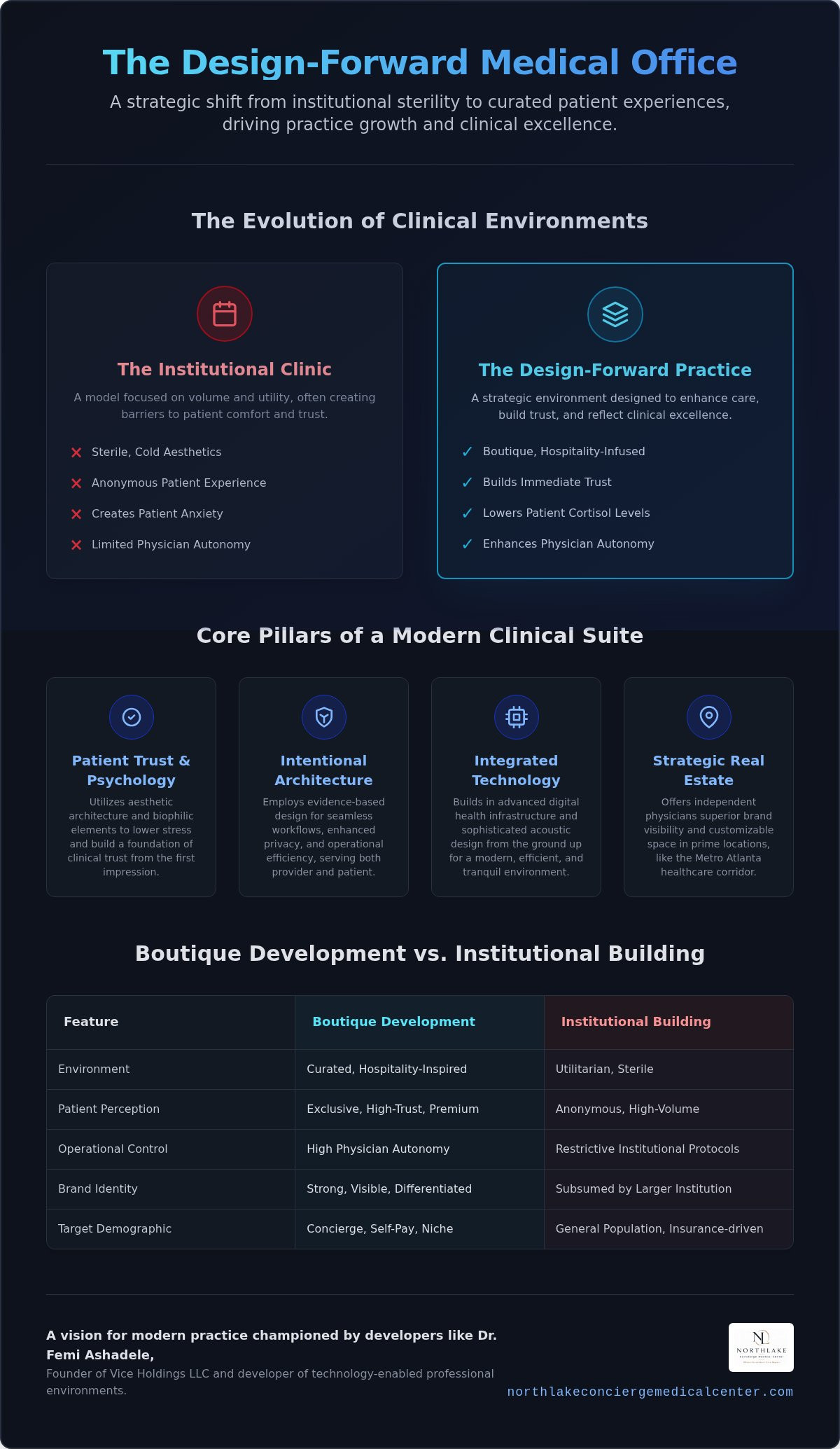
The era of the "cold" clinic is ending. In 2026, a design forward medical office is no longer just a workspace; it's a profound statement of clinical philosophy. For independent practices in Metro Atlanta, this shift represents a strategic pivot toward boutique medicine. It's an intentional departure from the utilitarian, high-volume models of the past. Physicians are now recognizing that the physical environment is a core component of the treatment plan itself. By moving away from institutional layouts, practices can foster an atmosphere of peace and professional pride that resonates with high-tier patient demographics.
Choosing a sophisticated aesthetic isn't merely about vanity. It's a calculated business decision. In a market where patients have increasing choices, prestige acts as a powerful differentiator. Concierge and self-pay patients, in particular, expect their healthcare environment to mirror the quality of the hospitality and luxury services they frequent. Integrating Evidence-based design principles ensures that these aesthetic choices also support better clinical outcomes by reducing patient anxiety and improving provider workflow. This harmony between form and function is what defines the modern elite practice.
Beyond the Sterile Aesthetic
Moving past the traditional "white-box" clinic requires a commitment to warm, professional luxury. It's about replacing flickering fluorescent lights with layered, natural illumination and swapping plastic seating for ergonomic, high-end finishes. These choices don't just look better; they reflect a physician's unwavering commitment to quality. When a patient enters a space that feels curated and exclusive, the perceived value of the care they receive rises. You can see this vision of refined clinical space in the latest renderings for boutique developments in the Northlake corridor. It's where clinical reliability meets the privacy and comfort of a private club.
Intentionality in Clinical Architecture
Sophisticated functionality in 2026 means that every square foot must be purposeful. Design isn't just about what you see, but how the space moves. A design forward medical office minimizes the friction of daily operations. It allows for seamless transitions between consultation and treatment while maintaining the highest standards of patient privacy. This requires a deep understanding of how technology and human interaction intersect in a modern medical setting. A design-forward medical space is a fusion of luxury hospitality and surgical-grade precision. By prioritizing intentionality, providers like Dr. Femi Ashadele are helping physicians create environments that serve the provider's efficiency as much as the patient's comfort.
The Clinical Psychology of Aesthetic Architecture
Architecture is a silent communicator. It speaks to the patient’s subconscious long before the physician enters the room. In a design forward medical office, the environment is engineered to lower patient cortisol levels and mitigate the physiological effects of stress. High-stress environments often trigger "white-coat hypertension," which can skew clinical data and complicate the diagnostic process. By utilizing calming palettes and sophisticated textures, a practice establishes a foundation of safety. This isn't just about comfort; it's a clinical tool used to enhance diagnostic accuracy.
The return on investment for high-end design begins at the front door. A refined exterior and lobby signal professional competence and success. This "First Impression ROI" builds a reservoir of trust that makes subsequent clinical conversations more productive and collaborative. Staff also benefit deeply from this environment. A prestigious, well-organized workspace serves as a powerful recruitment asset in the competitive Metro Atlanta labor market, helping practices attract elite talent and reduce the costs associated with staff turnover.
The Science of Patient Trust
Clean, modern lines act as visual proxies for sterility and clinical safety. High-end interiors suggest that a practice is both thriving and technologically current, which reassures patients of their own safety. Integrating biophilic elements, such as natural wood and soft greenery, has been shown to accelerate healing and reduce perceived pain levels. This approach aligns with the Whole Building Design Guide, which emphasizes creating environments that support human well-being alongside technical requirements. You can explore how these psychological principles come to life in our latest renderings for the Harobi Drive development.
Provider Pride and Performance
Physicians are not immune to their surroundings. A cluttered or outdated office contributes to cognitive fatigue and eventual burnout. In contrast, a "professional sanctuary" allows independent specialists to perform at their peak. Design-forward layouts improve clinical flow by separating patient paths from administrative zones, ensuring that the day moves with rhythmic precision. This intentionality reduces the daily friction of practice management and fosters a sense of professional pride. If you are ready to elevate your practice’s physical identity, consider how a customizable suite could serve as your next professional sanctuary.
Boutique vs. Institutional: A Strategic Real Estate Comparison
Large hospital-owned medical office buildings often function as anonymous labyrinths. For the independent specialist, this lack of identity is a significant business liability. Patients frequently find themselves lost in a maze of identical corridors, stripped of the personalized experience they expect from a high-tier provider. In these institutional settings, your practice becomes just another suite number. Choosing a design forward medical office in a boutique environment allows you to reclaim your brand's physical presence and operational autonomy.
The "flight-to-quality" trend in the Metro Atlanta market is accelerating as physicians move away from traditional, high-rise medical parks. Modern practitioners are prioritizing visibility and signage that reflect their unique professional identity. By opting for a boutique development, you gain the ability to curate the entire patient journey from the moment they pull into the parking lot. This control is essential for establishing the prestige and exclusivity required for concierge and specialty care models.
Institutional Medical Parks: The Hidden Costs
Institutional medical parks carry significant hidden costs that extend beyond the lease rate. Patients face the friction of multi-level parking decks, long wait times for elevators, and the sterile, often crowded atmosphere of shared waiting rooms. This "institutional fatigue" negatively impacts patient satisfaction before the clinical encounter even begins. Furthermore, corporate-owned suites often restrict your branding to a uniform door plaque, offering zero opportunity for professional differentiation. This is why many visionary providers are seeking Class-A Medical Office Suites in Tucker: Elevating the Boutique Practice to escape these standardized limitations.
The Boutique Advantage for Concierge Care
A boutique setting offers direct-to-door patient access, which is a powerful differentiator for high-end practices. This simplicity reinforces the "exclusive" feel that concierge patients demand. Independent specialists are increasingly gravitating toward the Northlake corridor and Harobi Drive because these locations offer strategic proximity to the Emory University Orthopaedics & Spine Hospital without the administrative overhead of a hospital-owned campus. These environments allow for customizable, build-to-suit options that accommodate specific clinical needs and advanced technology. Under the leadership of Dr. Femi Ashadele, Founder and Managing Member of Vice Holdings LLC, boutique developments are being designed to provide the operational control and prestige that institutional campuses simply cannot match. A design forward medical office in this context isn't just a suite; it's a strategic asset that supports your practice's long-term growth and identity.
Core Pillars of a Design-Forward Clinical Suite
A design forward medical office in 2026 is defined by the seamless integration of high-tier functionality and tactile luxury. It isn't enough for a space to look premium; it must perform at a surgical grade. This requires a meticulous approach to infrastructure that anticipates the needs of modern specialty practices. From the way light hits a surface to the way sound travels between exam rooms, every element is a pillar of clinical excellence. Success lies in balancing these sensory details with the rigorous demands of a technology-heavy medical environment.
Spatial flow is another critical component of the modern suite. Designers are moving away from the crowded, central nursing station model toward decentralized layouts that prioritize patient privacy and provider movement. By creating distinct zones for clinical work and administrative tasks, a practice can maintain a calm, uncluttered atmosphere even during peak hours. This intentionality ensures that the environment remains a "professional sanctuary" for the physician while offering a stress-free experience for the patient.
Technology-Enabled Environments
Modern clinical suites now require a digital backbone as robust as their physical one. As digital health and telehealth become standard, your office must support high-speed, secure data transmission without compromising the aesthetic. This is where the visionary approach of Dr. Femi Ashadele, Founder and Managing Member of Vice Holdings LLC, becomes a distinct advantage. Drawing on his background as a software engineering and cybersecurity professional, the Harobi Drive development prioritizes tech-enabled infrastructure. These buildings don't just house technology; they protect it. Integrated smart building features allow for automated climate control and lighting, while secure, dedicated server spaces ensure that your practice’s digital assets remain protected from evolving threats.
Materials and Sensory Experience
The choice of materials in a boutique clinic must marry durability with an elite, hospitality-inspired feel. We are seeing a shift toward antimicrobial surfaces that utilize sophisticated textures rather than the flat, porous plastics of the past. These high-end finishes are easier to sanitize and provide a tactile sense of quality that patients associate with superior care. Acoustic privacy is equally critical. In concierge medicine, the expectation of discretion is absolute. Advanced sound masking and specialized wall construction are essential to prevent cross-talk and maintain a quiet, meditative atmosphere. For those specializing in aesthetic or procedural fields, you can find specific insights on Refined Medical Office Design for Specialized Practices. If you are ready to begin your own build-to-suit planning, we invite you to connect with our development team to discuss your unique clinical requirements.
Realizing Your Vision at Northlake Concierge Medical Center
Northlake Concierge Medical Center represents the pinnacle of specialized healthcare real estate in Metro Atlanta. Situated on Harobi Drive, this development serves as a response to the growing demand for a design forward medical office that prioritizes the physician's unique brand. Under the visionary leadership of Dr. Femi Ashadele, Founder and Managing Member of Vice Holdings LLC, the project combines high-tier aesthetic standards with the rigorous security and technology requirements of modern medicine. Dr. Ashadele’s background as a technology executive and cybersecurity professional ensures that every suite is built on a foundation of operational excellence and digital safety. It is a space where professional pride and clinical precision coexist.
The development is strategically positioned to serve the most affluent corridors of the city. By offering a central hub near the I-285 and I-85 interchange, it provides an accessible destination for patients traveling from Brookhaven, Buckhead, and the expanding Northlake area. This geographic advantage is paired with a commitment to boutique exclusivity, ensuring that your practice remains a destination of choice for those seeking concierge care. It is more than just a building; it is a curated environment designed to elevate the standard of independent practice.
A Boutique Destination in Tucker
Securing a Class-A address in Tucker allows your practice to benefit from high visibility without the congestion of a massive hospital campus. This location places you in the heart of a growing medical community, minutes from the Emory University Orthopaedics & Spine Hospital. Positioning your practice here means joining a community of high-end wellness and specialty providers who value quality over volume. The architectural intentionality of the site ensures that your office stands out as a premier professional destination. You can view the latest renderings of the project to see how these design-forward principles translate into a sophisticated physical reality.
The Path to a Custom Medical Suite
The journey toward a truly design forward medical office begins with a collaborative build-to-suit process. Unlike standardized corporate leases, our approach offers the clinical autonomy and operational control that independent physicians require. You have the opportunity to influence every detail of your layout, from the spatial flow of the exam rooms to the integration of advanced diagnostic technology. This level of customization ensures that your physical environment is a perfect reflection of your clinical expertise. When you choose a bespoke suite, you aren't just leasing space; you're investing in a strategic asset that supports long-term patient retention and professional satisfaction. We invite you to contact Northlake Concierge Medical Center for a private consultation to discuss the future of your practice.
Defining the Future of Your Independent Practice
The future of independent medicine requires a departure from the sterile, high-volume models of the past. By prioritizing a design forward medical office, you choose an environment that actively builds patient trust and supports clinical precision. We have explored how intentional architecture reduces white-coat hypertension and how boutique settings offer the operational control missing from institutional high-rises. This shift isn't just about aesthetics. It's about claiming your place in an elite market that values quality and exclusivity.
Northlake Concierge Medical Center stands as the premier destination for this transition in Tucker, Georgia. This boutique Class-A development offers the customizable build-to-suit planning necessary for specialized practices. With strategic access to the I-285 and I-85 interchange, it positions your brand within minutes of the city’s most affluent corridors. You don't have to compromise on your practice’s physical identity when you have a partner dedicated to visionary design and technical security.
Secure your design-forward medical suite at Northlake Concierge Medical Center today. Your vision for a sophisticated, tech-enabled practice is within reach.
Frequently Asked Questions
What exactly does 'design-forward' mean for a medical office?
A design forward medical office represents a shift from sterile, institutional clinics toward hospitality-infused professional spaces. It prioritizes intentionality through sophisticated aesthetics and high-tier functionality. Every architectural choice, from layered lighting to tactile materials, aims to create an elite patient experience. This approach ensures the physical environment reflects the premium quality of care provided, moving beyond the utilitarian standard to establish a prestigious brand identity for independent physicians.
How does medical office design impact patient retention?
The physical environment acts as a silent partner in patient retention by directly influencing psychological comfort and trust. Research into evidence-based design shows that calming, refined spaces can lower patient cortisol levels and reduce anxiety. When a patient feels they are in a secure, high-end environment, their perceived value of the care increases. This "First Impression ROI" builds a reservoir of trust that encourages long-term loyalty and satisfaction within independent practices.
Can a design-forward office still meet strict clinical and HIPAA standards?
Modern design-forward layouts prioritize clinical integrity alongside aesthetic appeal and strict HIPAA requirements. You can integrate antimicrobial surfaces that offer sophisticated textures instead of porous plastics, ensuring surgical-grade hygiene. Compliance is maintained through advanced acoustic design, including sound masking and specialized wall construction to protect patient privacy. These features are seamlessly woven into the architecture, proving that a boutique medical office can be both visually stunning and rigorously compliant.
Is boutique medical real estate more expensive than traditional MOBs?
Boutique medical real estate offers superior long-term value through higher patient retention and lower staff turnover despite its Class-A status. In the Atlanta market, medical office buildings trade at higher premiums than traditional offices because of their resilient demand. Investing in a boutique space allows for customizable layouts and operational control, which reduces the hidden costs of institutional friction, such as parking decks and shared waiting rooms often found in hospital-owned buildings.
What are the benefits of a build-to-suit medical suite in Atlanta?
Build-to-suit planning offers independent physicians complete clinical autonomy and the ability to tailor every square foot to their specific workflow. In a competitive market like Metro Atlanta, this allows specialists to integrate advanced technology and unique diagnostic infrastructure from the initial design phase. This level of customization ensures that the spatial flow supports both provider efficiency and patient privacy, creating a "professional sanctuary" that reflects the physician’s unique brand and elite standards of care.
Why is the Northlake/Tucker corridor becoming a hub for independent physicians?
The Northlake and Tucker corridor is emerging as a premier boutique physician destination due to its strategic accessibility near the I-285 and I-85 interchange. This location allows practices to serve affluent patient bases from Brookhaven, Buckhead, and Decatur without the congestion of downtown campuses. Proximity to the expanding Northlake corridor provides a strong market context, while developments like the one on Harobi Drive offer the visibility and signage required for independent practice growth.
How does technology integration factor into design-forward medical spaces?
Technology is the digital backbone of a design forward medical office, requiring robust infrastructure that supports cybersecurity and digital health. Modern suites integrate telehealth capabilities and smart building features, such as automated climate control, directly into the architectural plan. This ensures that high-speed data transmission and secure server spaces don't compromise the refined aesthetic. For independent specialists, this tech-enabled environment provides a secure, future-proof workspace that maintains the highest standards of data protection.
What role does Dr. Femi Ashadele play in the Northlake Concierge development?
Dr. Femi Ashadele is the Founder and Managing Member of Vice Holdings LLC and the visionary developer behind the Harobi Drive project. His authority is drawn from a deep background as an Atlanta-based developer, technology executive, and cybersecurity professional. Dr. Ashadele oversees the transformation of the property into a Class-A medical destination, ensuring that every suite meets his high standards for operational efficiency, modern professional aesthetics, and secure, technology-enabled infrastructure.


